Transformation. Software. Design.
DIDA
DIDA
Digital public services
In the preliminary study commissioned by the Mercator Foundation, I explain why a technical infrastructure is required for the expanded provision of public services. In many life situations, people currently find little or no help in the digital space. The document analyses current problems and presents a proposed solution, here under the working title DIDA.
The study, supporting material and an FAQ are further down this page.
You can find out more about the rest of my work on my homepage:
APIs instead of apps, protocols instead of platforms
Germany rarely lacks good services in the expanded provision of public services — what it lacks is discoverability, interoperability and connecting infrastructure. Many services of real social value exist alongside one another instead of with one another. For citizens, the result is often a patchwork of searching, chance and broken digital journeys.
DIDA in brief
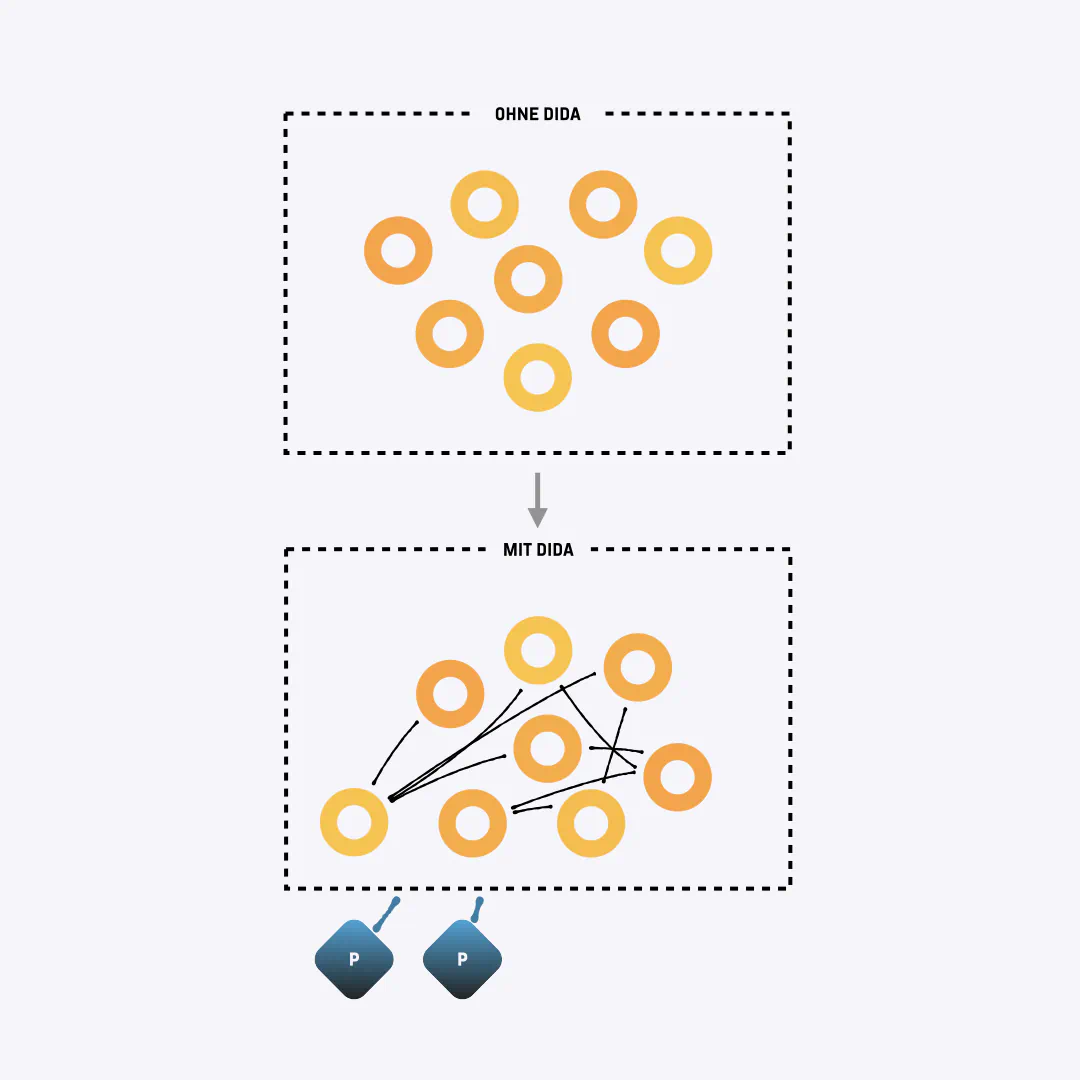
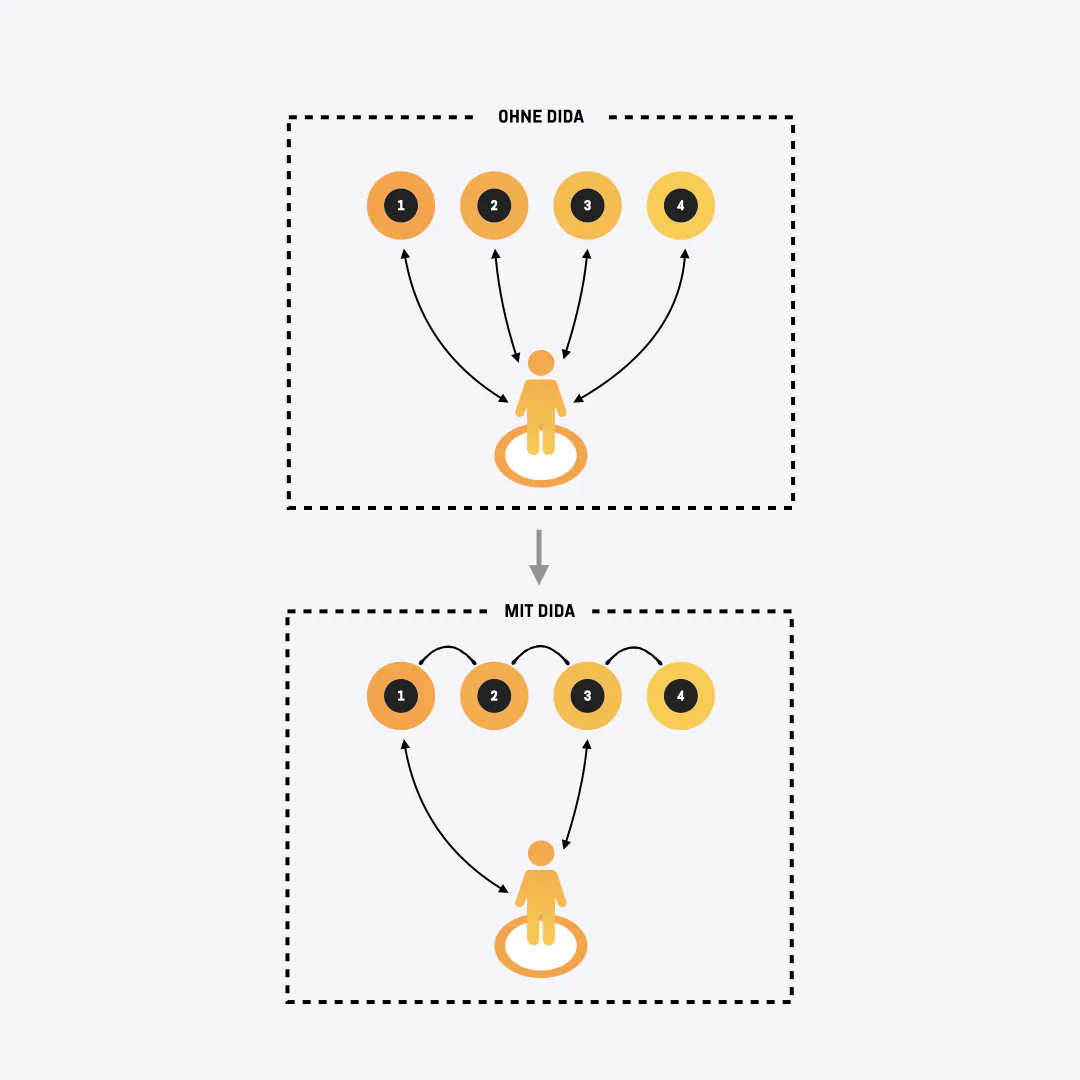
Anyone who needs support in a new life situation — because a child is on the way, for example — currently works their way from one service to the next. Information is scattered, responsibilities are unclear and digital routes break down. You have to know what to search for in the first place. This is exactly where the DIDA concept comes in: digital public services as a network.
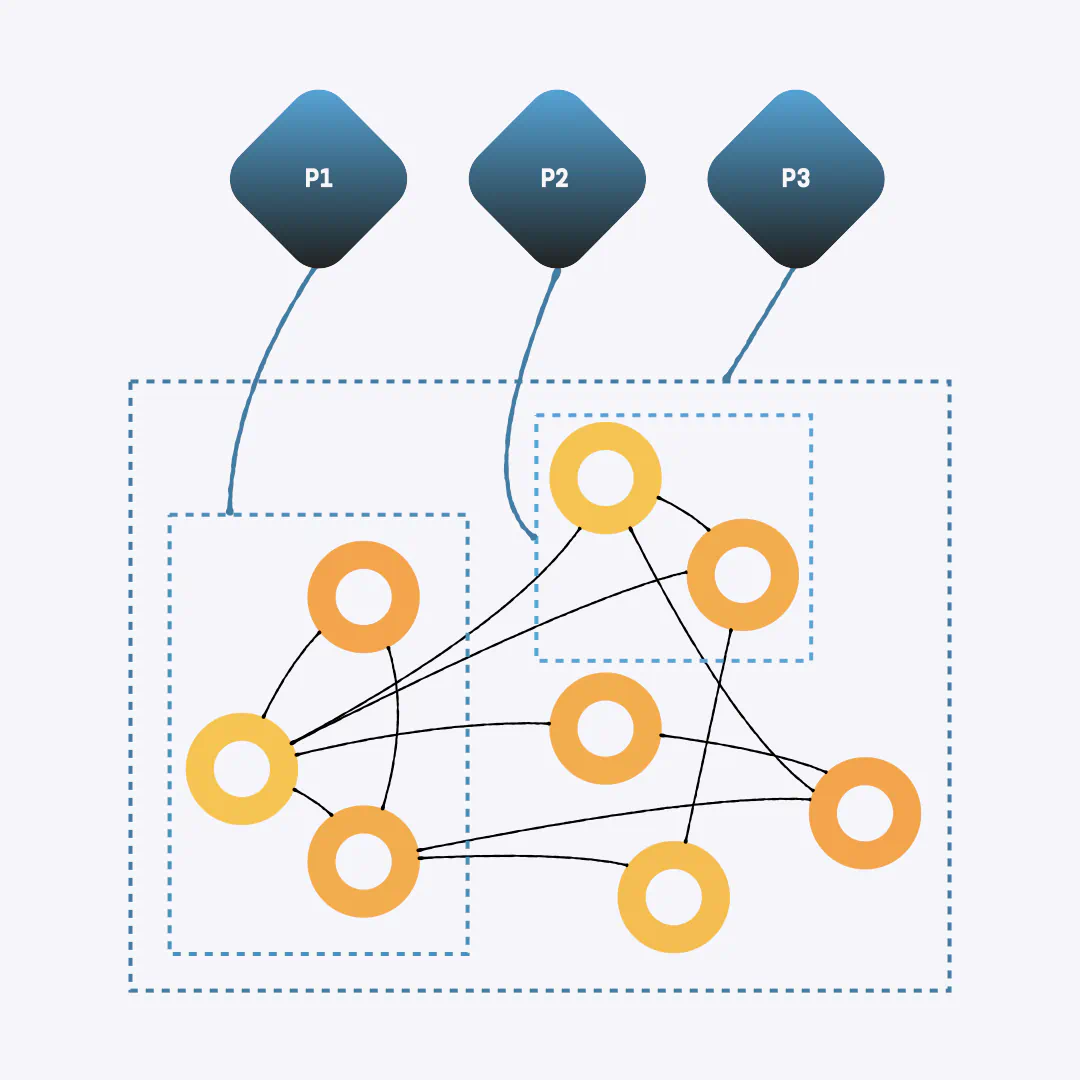
Instead of yet another super app or (central) platform, what is needed are digital interfaces, known as APIs. They let programs exchange data in a controlled and efficient way, rather than making people enter the same information over and over again. Services stay decentralised with their respective providers, and only the necessary connections are established. Consent, data minimisation and decentralised storage are the guiding principles of this approach.
DIDA can and should dock on to existing initiatives: connectors to the Deutschland-Stack and the Sozialplattform make it easy to use public, quasi-public, private-sector and civil-society services alike.
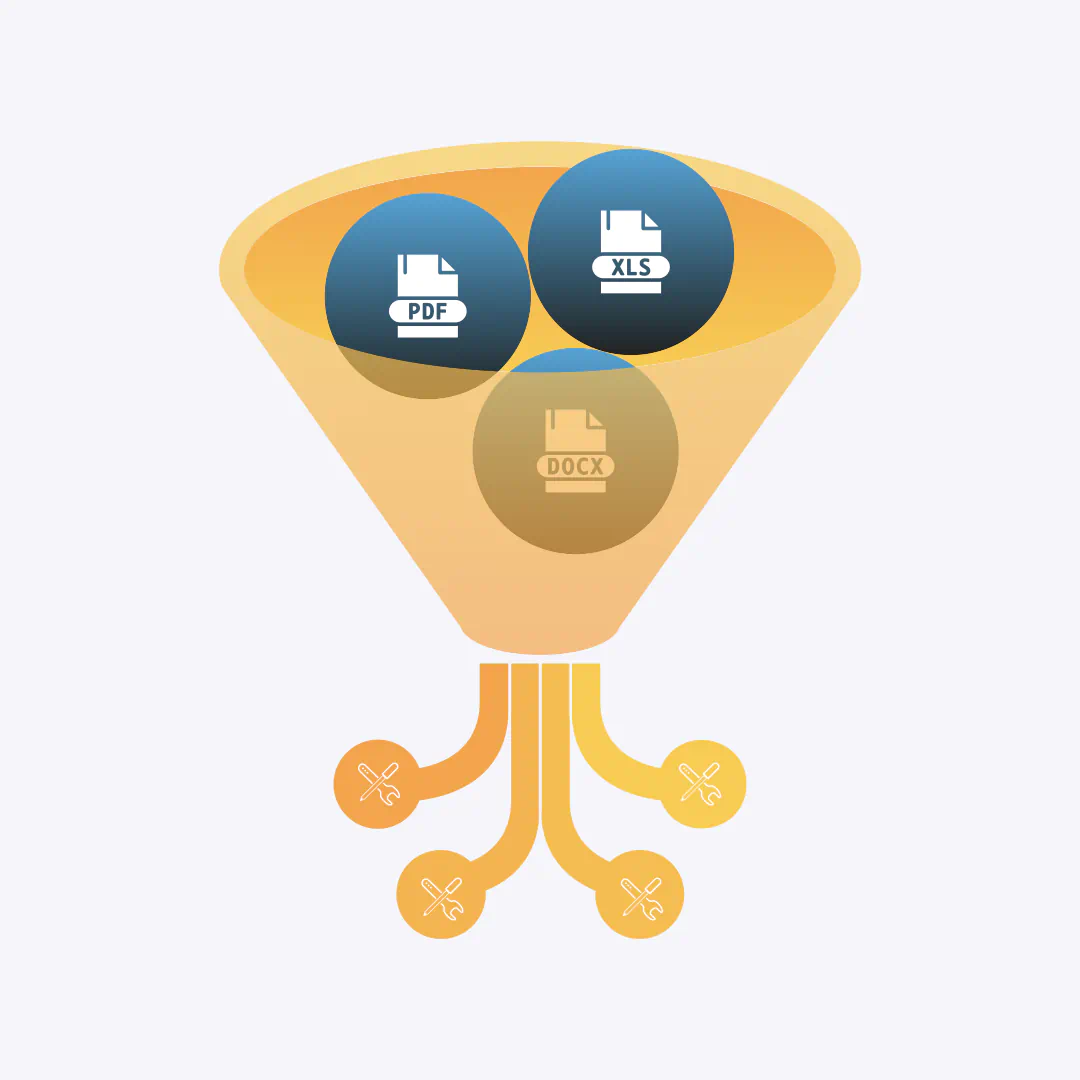
DIDA has to relieve the burden on providers of public services first, rather than oblige them. The study proposes setting up a DIDA service agency to offer practical support. AI-based tools can help to capture information from a wide range of services and translate it into consistent structures. What seemed barely solvable five years ago is feasible today thanks to AI. The services already exist. What is missing is the infrastructure to make them digitally accessible and to link them into a chain of services.
The same case, two routes.
Pick a life situation and click your way through it: first the way it works today, then with DIDA. The life situations are simplified, but are meant to give a good overall picture of everyday challenges. If you spot any errors or have comments, use the feedback button once you have started the simulator. After playing through both runs (“Today” and “With DIDA”), you will get an overview of how DIDA could make life easier in challenging situations.
Choose a life situation.
All places and providers are made up. The routes are not.
Study and supporting material

DIDA: Digital public services
Published in April 2026, the study describes the current problems of the expanded provision of public services in the digital world. It sets out the challenges from the perspective of the public sector, of the providers of public services and of citizens, and outlines an approach to solving them with the DIDA concept.

"Whether I have everything I need to live should not be left to chance"
In conversation with "Auf Ruhr", the magazine of the Mercator Foundation, I explain the fundamental concept of DIDA. Which concrete, everyday examples are there? What contribution could DIDA make to society?

A service that relieves rather than obliges
Booking a trip to Mallorca online is easy – hotel, hire car and insurance included. Claiming public services, by contrast, is complicated, laborious and slow. Why is that?
Posts on DIDA
The latest posts on DIDA from my blog. All posts are in German.
Frequently asked questions
- What does "expanded provision of public services" mean?
The provision of public services covers the services and infrastructure that are essential to social and economic life. DIDA deliberately uses a broader definition of the term.
Alongside classic government services, this can include advice services, social benefits, midwife placement, services for families, cultural and leisure activities or help in a crisis. They can be offered by the state, by welfare organisations, associations, social enterprises or other companies.
- What would DIDA actually change for me?
Today people often have to work out for themselves which services fit their situation. After that, a new process starts with every provider. With DIDA, these isolated stops could be linked into seamless chains of services. Anyone who has found a suitable service could be referred straight on to other relevant offerings. Where it makes sense and is legally permissible, information that has already been entered could be carried over with explicit consent.
The result: less searching, fewer duplicate entries, fewer broken digital journeys and better orientation.
- What does "life situation logic" mean in the DIDA context?
People do not normally think in terms of administrative responsibilities, form names or the right non-governmental institutions and their programmes. They experience actual life situations, such as "I am going to be a mother", "I have to organise care", "I have money worries" or "I need help with (digital) violence". And it is precisely in these situations that it becomes all the harder to think your way into structures that are highly abstract for those affected.
DIDA wants to think about digital public services from the perspective of such life situations. Suitable services from different organisations can be connected with one another even though they remain organisationally independent. This means that, starting from their life situation, people can find help step by step from different providers whose services complement one another.
- So will there be a new website? Or a new app?
Different points of access, known as frontends, are a key principle of DIDA. In the study, these access points (website, app, AI systems) are described as portals. Municipal portals, apps, services run by welfare organisations or other services could also connect to the infrastructure. People could additionally enter the network through a provider they already use. Above all, DIDA is the infrastructure behind these access points and is therefore frontend-agnostic.
For the launch, the preliminary study nevertheless recommends a pilot portal (as one of many ways in), so that the benefit of the network is immediately visible and tangible. Other access points can be developed freely by third parties.
- Aren't there already enough digitalisation projects?
Yes, but that is precisely part of the problem. Many projects each develop their own portals, data models and technical components. DIDA is therefore not meant to become simply the next silo. Instead, it is meant to create a reusable connecting layer between existing and future services.
The success of DIDA must therefore also be measured by whether duplicated development is avoided and existing structures are effectively integrated.
- Who can become part of the DIDA network?
DIDA is aimed in particular at non-governmental providers in the expanded provision of public services: regional companies, social enterprises and start-ups as well as civil-society organisations, welfare organisations and associations.
Public and quasi-public services can be connected too, provided they are not already digitally accessible through other government initiatives (e.g. through the Deutschland-Stack or the Sozialplattform). See also the question on the Deutschland-Stack.
- What is in it for (non-governmental) providers?
DIDA can improve how easily services are found and how well they connect technically. In addition, basic technical components do not have to be developed from scratch by every organisation. A further benefit lies in the network itself: services can refer users on to other services and in turn be found by them. Beyond that, DIDA can act as a joint point of contact for politics and public administration on technical standards and cooperation.
- Why should organisations that are already stretched take part at all?
Social institutions often have only limited staff resources and capacity for additional digitalisation projects. DIDA should make providers' work easier and offer an immediately recognisable benefit.
The preliminary study therefore proposes, among other things, simple onboarding processes, software development kits (SDKs), reference implementations, AI tools, test environments and technical support from a DIDA service agency. The service agency has to make it possible for providers to become part of the network even without technical expertise.
- Why should providers cooperate when they are partly competitors?
DIDA does not seek to abolish competition; it separates "competition at the level of services" from "cooperation at the level of infrastructure". Shared technical standards can benefit competing services as well. The internet itself is based on this principle: shared protocols promote competition and diversity rather than hindering them. DIDA wants to transfer this principle to digital public services.
- What does DIDA offer the public sector?
The state gains structured technical access to a highly fragmented area of public services. Shared standards and connectors enable bundled access instead of having to build individual interfaces and partnerships for every single provider. As a result, the state does not have to develop every socially valuable digital service itself. Public funds can therefore be invested more heavily in reusable infrastructure instead of repeatedly creating expensive one-off solutions.
- Does DIDA store all data centrally?
No, DIDA is explicitly designed as decentralised infrastructure. The participating services remain independent, and data should as far as possible stay where it arises and is needed. DIDA provides the technical rules and connections that allow services to communicate with one another. This is what sets the approach apart from a central "super database".
- What role does the EUDI wallet play?
The European EUDI wallet could establish itself as an important building block for proof of identity in future. Instead of always having to present complete documents, for example, users could prove just the attributes that are actually needed. DIDA itself does not become a wallet; it acts as an intermediary between the services, while the wallet provides identity and verified attributes.
- How does DIDA relate to the Deutschland-Stack?
Both approaches rest on a common infrastructural principle: using shared components, standards and interfaces instead of isolated solutions. The Deutschland-Stack concentrates on digitalisation in the public sector. DIDA extends this approach to the broader provision of public services and in particular to non-governmental providers. A connector between the Deutschland-Stack and DIDA would therefore make sense in the longer term. It would give public bodies a defined point of connection to a broad non-governmental ecosystem.
- Won't AI soon make DIDA superfluous?
AI is at its best when dealing with information that is digitally available, structured and machine-readable. Yet these are precisely the qualities that many services in the provision of public services lack. DIDA remedies this by providing responsibilities, services, interfaces and trust information in a structured form, and thus offers reliable infrastructure for AI systems. The key question is therefore not "DIDA or AI?" but: "On what infrastructure should AI organise the provision of public services in future?"
- Can DIDA also make services that have so far been analogue findable digitally?
This is a medium to long-term goal. Smaller providers in particular often have no structured or online-accessible digital data. Many do not even have a website of their own.
The preliminary study therefore proposes using trustworthy AI tools to convert existing documents into standardised, machine-readable information. Providing such tools would essentially be the job of the DIDA service agency. Occupancy plans, for example, could then be made available through interfaces without small organisations having to develop APIs themselves or even having to know what APIs are.
- What requirements should there be for becoming part of the DIDA network?
The question of which minimum standards and admission criteria should be laid down bindingly in the further development process has not yet been conclusively settled. The preliminary study recommends taking account of requirements for data protection, information security, technical interoperability and quality. Beyond that, it is important that the conditions for connecting are transparent and non-discriminatory. In addition, awarding certificates or quality seals could be considered for certain providers. Third parties could in theory also help to highlight quality features or make them comparable.
- Isn't a DIDA standard enough? Why is a DIDA service agency needed?
Providers of public services are currently poorly positioned in digital terms. The mere existence of standards is not enough to ensure interoperability. What is needed is development, documentation, practical implementation, testing and support with integration by a central actor. The preliminary study therefore proposes setting up a DIDA service agency. It would develop standards together with the actors involved, provide technical tools, onboard providers and organise reliable operation of the infrastructure.
The service agency is intended to bundle responsibility and keep the integration effort as low as possible. The preliminary study emphasises that infrastructure does not arise from norms alone, but through institutionalised responsibility, technical expertise and continuous operation.
- How is DIDA to be financed?
For the build-up phase, the preliminary study assumes public start-up funding over at least four years. Funds from foundations, European funding programmes and earmarked contributions from the private sector could be available in addition.
As DIDA matures, commercial providers could contribute to refinancing, for example through membership fees, revenue sharing ("affiliate system"), infrastructure or certification fees and chargeable support services.
The concrete financing model has not, however, been finally settled.
- What is still open at this point?
The preliminary study is deliberately not a finished implementation plan. Among other things, concrete technical standards, governance, legal and organisational form, admission criteria, certification models, financing and initial pilot sectors need to be worked out further. A detailed business plan and the final technical architecture are also not part of the preliminary study.
The next step is therefore not to keep planning DIDA in theory alone, but to develop and trial it in practice together with potential providers, the public sector and technical experts, on the basis of concrete use cases. The preliminary study describes this as the first phase of the DIDA service agency.
- How can I support the DIDA idea?
At the moment, one thing helps above all: attention. Talk about it, share this website and its content. If you are a provider of public services yourself, or if you work in politics or public administration, I would be delighted to hear from you.